Crazy number to know before you vote
More than 13,000 Oklahomans out of 2.42 million registered voters in Oklahoma changed their political party for this election. Why? Most wanted to vote on the much more competitive Republican primary.
- 3,600 Independents became Democrats.
- 2,400 Independents became Republicans.
- 2,300 Democrats became Republicans.
- 1,700 Republicans became Independents.
- 1,400 Democrats became Independents.
- 1,100 Republicans became Democrats.
- 150 Libertarians became Democrats.
- 150 Libertarians became Independents.
- 100 Libertarians became Republicans.
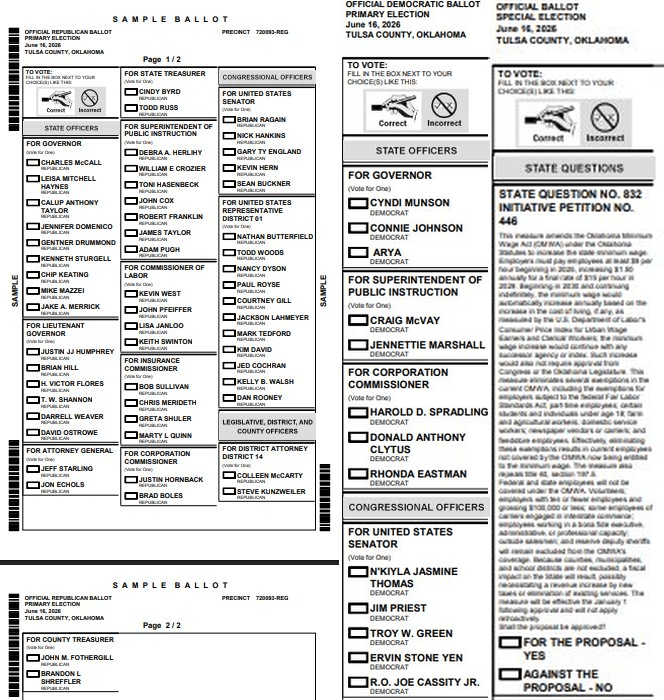
What you have to vote on by political party
- Republicans have at least 12 candidate races to vote on and a state question.
- Democrats have at least 4 candidate races to vote on and a state question.
- Independents only have the state question to vote on.
Download what your ballot will look like Tuesday
- Put in your name and birthdate on this site: Oklahoma Voter Portal.
- Scroll down and click Sample Ballot. You can download it as a PDF.
- It will also remind you where you will vote (those locations always have a tendency to change).
Read up on what everyone – no matter their political party – will vote on: State Question 832
- Quickly: Proposes raising Oklahoma’s minimum wage by $1.50 a year for a final rate of $15 per hour in 2029. The next year, Oklahoma’s minimum wage would automatically increase annually based on the Consumer Price Index.
- Oklahoma Voice: What supporters and opponents have to say.
- Oklahoma Watch: Frequently asked questions answered by Reporter Keaton Ross.
- NonDoc: How other states have fared and what increases could mean for small business by Reporter Matt Patterson
- KOSU: Why Oklahoma’s minimum wage question might look strange to voters by Reporter Natalie Armour
- Tulsa World: 5 things to know about State Question 832 to raise the minimum wage by Breaking News Editor Anna Codutti
- Tulsa Flyer: More answers to FAQs by Reporters Libby Hobbs and Ismael Lele
What a doctorate in economics has to say about raising the minimum wage
A fellow Collington Indexer, with a doctorate in economics, with this take:
While it is possible that raising the minimum wage may contribute to price inflation, and some small businesses may have trouble covering the increase initially – and have to let some workers go – these objections are based on short-term thinking.
Many aspects of our current economic situation already contribute to inflation, and increases in the low wages of hourly workers would not impact those prices. For example, the prices of oil, gasoline, fertilizer, crops, livestock are not based in large part on labor input costs. Phasing in the wage increases also lessens the immediate impact of increased labor costs. I do not recall massive layoffs or record inflation the last time the minimum wage was increased nationally.
Wage increases also do not happen in a vacuum. With an increase in income, low-wage workers will now better be able to afford things – groceries, doctor visits, car repairs, for example. They may also be more willing to afford recreational goods and services (date nights, toys, trips). They may buy more expensive things (Get a shirt and pants from Dillard’s instead of Temu. Buy more steak instead of hamburger).
In the longer term, firms will have to increase output to meet the increase in demand from consumers whose incomes have risen. They will need to hire more workers to either produce more goods or to provide services to consumers. This means more income flowing through the economy. So in the long run, firms may end up with greater profits even after the increase in labor costs.
Increased wages also provides a benefit to state and local governments – an increase in the tax base without increasing taxes. More purchases of goods and services increases sales tax revenue (though some goods have sales tax exemptions, so this is not true across the board obviously). It may also provide a boost to income tax revenues (although a lot of minimum wage workers probably do not make enough to pay much in income taxes).
In the end, raising the minimum wage does benefit the living standards of hourly workers, but isolated from other policy changes (lowering the cost of health care; lowering the cost of day care for children and elders; affordable, adequate housing) the impact is probably limited.
Read up on the candidates on your ballot
Here are links to all the election guides from local news sources in one place:
- Oklahoma Voice: The staff offers two guides, one that is office specific and the other with story coverage.
- KOSU: All of their coverage in one place.
- The Oklahoman: Links to coverage and answers to FAQs.
- Tulsa World: Reporters Randy Krehbiel, Lenzy Krehbiel-Burton and Steve Metzer offer insights on each candidate.
- Tulsa Flyer: Coverage from multiple sources.
- NonDoc: The most in-depth of any news source so far with stories with previews on almost every race across the state.
Reminders
- You can vote Tuesday from 7 a.m. to 7 p.m.
- Bring your photo ID to your polling place so you can vote.
- A number of candidates ended their campaign for an elected position but will still appear on the ballot. They include Republican Dan Rooney for U.S. Representative in District 1 and Democrat John Waldron in Oklahoma House District 77.
- It is likely that a number of races will require a run-off election, which is set for Tuesday, Aug. 25, 2026. In that election, the two candidates with the highest number of votes appear on the ballot.
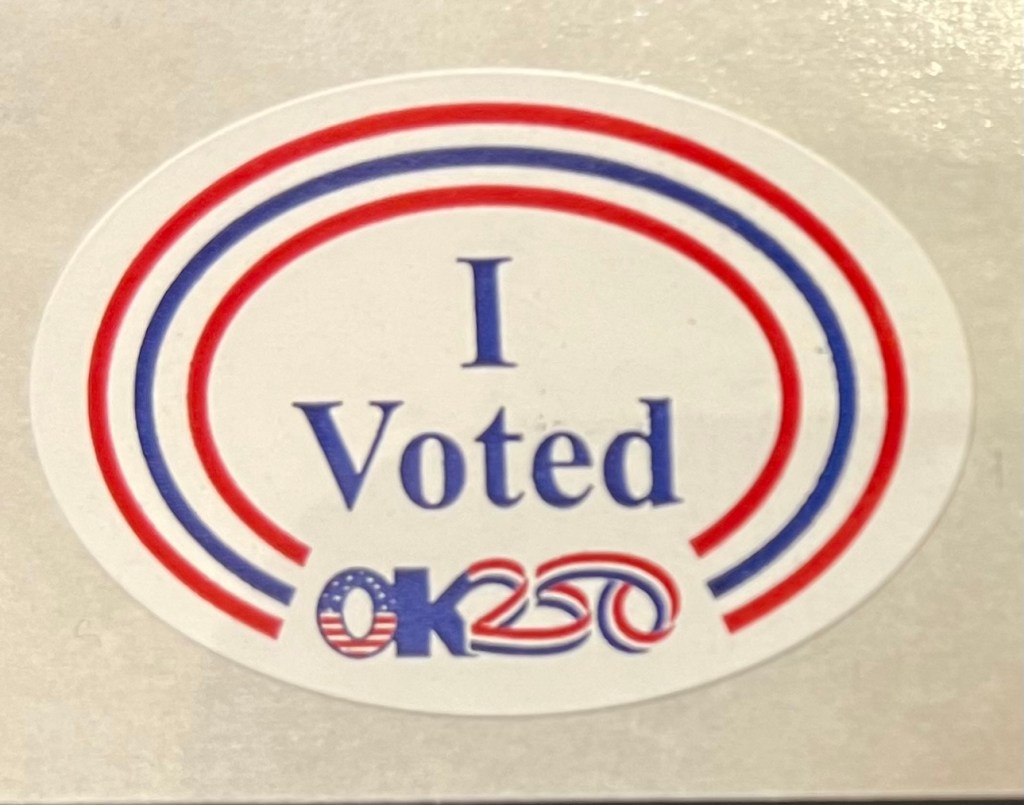
Get your sticker
This is what the new “I Voted” stickers will look like this year.
Forward this to your friends and neighbors who might be cramming for this election as well.
Encourage them to subscribe for free to the Collington Index.

